
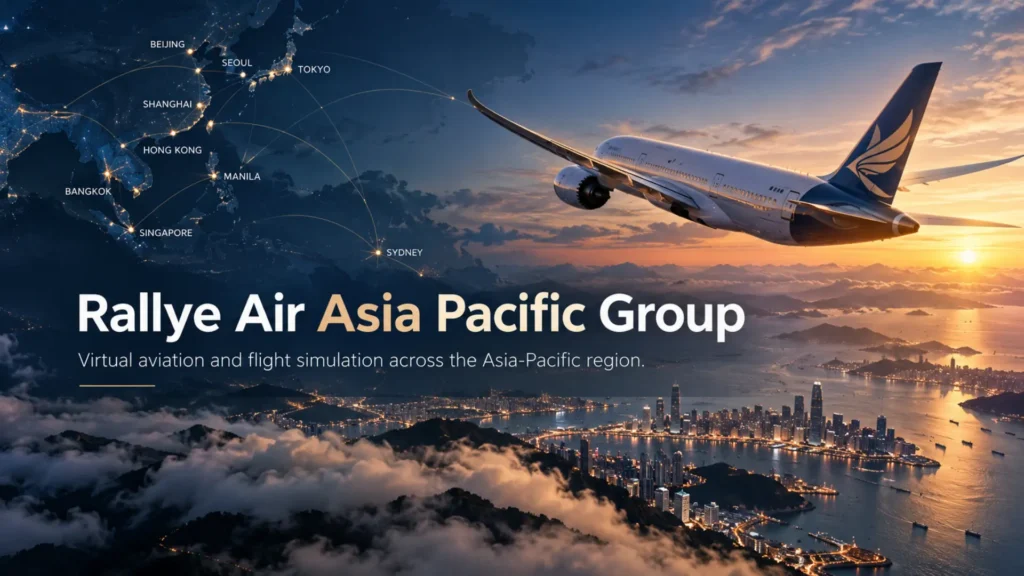
Rallye Air Asia Pacific Group: A World of Virtual Aviation and Flight Simulation
Aviation connects countries, communities, and cultures through a complex network of airports, aircraft, airways, and flight operations. Flight simulation provides an opportunity to explore many aspects of this network through computer-based environments that reproduce selected characteristics of real-world flying. Rallye Air Asia Pacific Group represents an interest in virtual aviation, particularly the experience of simulated airline operations and aviation activities across the Asia-Pacific region. Within this field, aviation enthusiasts can study aircraft operations, understand flight planning procedures, and become familiar with the challenges involved in navigating different airspaces. Virtual aviation combines technical knowledge with practical decision-making, making it an engaging subject for people who enjoy learning how aircraft operate. Although a desktop simulator cannot reproduce every condition encountered during actual flight, it can demonstrate important relationships between aircraft performance, weather, navigation, and operational procedures. These subjects provide the foundation for understanding both the practical and recreational sides of simulated flying.
The Asia-Pacific region offers a particularly interesting environment for aviation exploration because of its geographical diversity and extensive network of international and domestic air routes. It includes major metropolitan airports, remote regional airfields, tropical island destinations, mountainous terrain, and long stretches of ocean. Each environment introduces different considerations for aircraft selection, route planning, weather interpretation, and airport operations. In a virtual environment, a short domestic flight may involve a straightforward route between nearby airports, while a longer international journey requires closer attention to fuel planning, navigation, and changing weather conditions. Modern flight simulation software can represent many of these elements through aircraft systems, airport models, navigation databases, and simulated atmospheric conditions. Online aviation communities add another dimension by allowing participants to experience coordinated flying and air traffic communication. Together, these activities demonstrate why flight simulation has developed into a detailed technical hobby with connections to real aviation knowledge.
Contents
Understanding Virtual Aviation and Simulated Airline Operations
Virtual aviation refers to the recreation of aviation activities within a simulated environment rather than through the operation of physical aircraft. Participants may fly general aviation aircraft, commercial passenger jets, cargo aircraft, or other simulated aircraft depending on the capabilities of their software. Some enthusiasts prefer short visual flights, while others focus on structured airline operations that follow planned routes and established procedures. A virtual airline is generally an organized simulation community that models aspects of airline activity, such as route networks, aircraft fleets, scheduled flights, and pilot records. These organizations are distinct from licensed commercial air carriers and do not transport actual passengers or freight. Their purpose is usually educational, recreational, or community-oriented, with different groups adopting different operating standards.
Simulated airline operations can involve several interconnected activities, including selecting an aircraft, reviewing an airport, preparing a flight plan, monitoring a journey, and recording its completion. Participants often use aviation terminology and publicly available procedural concepts to make these experiences more structured. However, the accuracy of any simulated operation depends on the software, aircraft model, navigation data, and procedures being used. A realistic-looking aircraft does not necessarily reproduce every system or performance characteristic of its real-world counterpart. Understanding these limitations is an important part of responsible flight simulation. The value of virtual aviation lies not only in completing flights but also in learning how different aviation systems interact during an operation.
The Geographical Diversity of the Asia-Pacific Aviation Region
The Asia-Pacific region encompasses some of the world’s most varied aviation environments, ranging from densely populated cities to isolated islands and large areas of open water. Airports in Australia, New Zealand, Southeast Asia, and the wider Pacific serve substantially different geographical and operational settings. Indonesia and the Philippines, for example, contain thousands of islands, making air transport an important means of connecting communities separated by water. Australia combines major coastal population centers with vast inland distances, while New Zealand presents distinctive terrain and weather considerations associated with its mountainous landscapes. These differences influence the types of routes, aircraft, and operating conditions encountered across the region. For flight simulation enthusiasts, geographical variation creates opportunities to explore both short regional journeys and extended flights between international airports.
Distance is a fundamental part of aviation planning because it affects journey duration, fuel requirements, and operational decisions. Aircraft navigation commonly uses the nautical mile, a unit defined as exactly 1,852 meters, rather than the statute mile typically used for road distances in some countries. A change of one degree in latitude corresponds to approximately 60 nautical miles along the Earth’s surface. These measurements help explain why aviation uses geographical coordinates, navigation fixes, and specialized distance calculations. The Asia-Pacific region also spans multiple time zones, making Coordinated Universal Time, or UTC, particularly useful for consistent aviation scheduling and communication. Understanding geography and standard aviation measurements adds practical context to the experience of planning simulated routes across this extensive region.
How Flight Planning, Aircraft Systems, and Virtual Operations Work Together
A structured flight consists of several interconnected phases, beginning before an aircraft leaves its parking position and continuing until the flight is completed. Preparation commonly involves identifying departure and arrival airports, reviewing weather conditions, selecting a route, and determining an appropriate aircraft configuration. During departure, attention shifts to ground movement, runway procedures, aircraft performance, and the initial climb. The en-route phase involves monitoring navigation, altitude, speed, fuel, and the progress of the aircraft along its intended course. Descent and approach procedures introduce further considerations, including terrain, airspace restrictions, runway availability, and changing atmospheric conditions. Finally, landing and ground operations bring the simulated journey to a conclusion.
Flight simulation attempts to represent these stages through a combination of flight dynamics, cockpit instruments, navigation systems, and environmental models. The level of detail varies considerably between aircraft and software platforms. Some simulations emphasize accessibility and visual flying, while others offer complex aircraft systems that require familiarity with checklists and operating procedures. Understanding these differences helps users establish realistic expectations about what a particular simulation can provide. A well-planned simulated flight is therefore more than a sequence of takeoff, cruise, and landing activities. It is an opportunity to examine how individual operational decisions affect the wider journey.
Navigation and the Importance of Accurate Flight Plans
Navigation is an essential component of aviation because pilots must determine their position, follow an intended route, and maintain awareness of nearby terrain and airspace. Modern airline navigation commonly combines satellite-based positioning, onboard navigation computers, and ground-based navigation aids where applicable. Flight plans describe important elements of a proposed journey, including departure and destination aerodromes, routing, cruising levels, and other operational information. In instrument flight operations, procedures are organized around established navigation requirements and air traffic management practices. Many flight simulators represent these concepts using flight management systems, navigation displays, and modeled radio-navigation equipment.
Airport identification is another important part of aviation navigation. The International Civil Aviation Organization uses four-letter location indicators for many airports and aeronautical facilities around the world. For example, Sydney Airport is identified as YSSY, Auckland Airport as NZAA, and Singapore Changi Airport as WSSS. These identifiers help distinguish aviation locations within international flight planning and operational systems. Simulated flight planning can use such identifiers to organize departure and arrival information accurately. However, airport procedures, navigation charts, and route structures may change over time, so the age and accuracy of navigation data remain important considerations whenever realism is a priority.
Air Traffic Control and Communication in Virtual Skies
Air traffic control plays an important role in organizing aircraft movements and maintaining safe separation within controlled airspace. In real-world aviation, controllers provide clearances, instructions, and relevant traffic information according to the services and airspace classifications involved. Pilot-controller communication relies on standardized terminology and procedures designed to reduce ambiguity. In simulated aviation, online networks can reproduce selected elements of these interactions by connecting virtual pilots with volunteer controllers. Such environments introduce participants to the structure of clearance delivery, ground control, tower operations, approach control, and area control. The extent of available services depends on the network and the controllers participating at a particular time.
A typical simulated departure may involve requesting clearance, obtaining taxi instructions, communicating before takeoff, and following additional instructions after departure. During arrival, a pilot may need to respond to altitude restrictions, route adjustments, and approach clearances. These exchanges can help users become more familiar with aviation phraseology and the importance of accurate readbacks. Good communication also requires awareness of aircraft position, current clearance, and the next expected phase of flight. Although virtual air traffic services can recreate aspects of operational coordination, they are not a substitute for certified flight training or real-world air traffic control experience. Their primary contribution is to make simulated flying more interactive and procedurally engaging.
Flight Records, Pilot Activity, and Aviation Communities
Flight records provide a structured way to document aviation activity, whether in an actual logbook or within a simulated flying environment. In virtual aviation, these records may contain departure and arrival airports, aircraft types, flight durations, dates, and other information associated with completed journeys. Some virtual airline systems use pilot reports to organize activity and maintain historical records of simulated operations. Such records can help enthusiasts compare different routes, review previous flights, and develop a clearer understanding of the types of operations they have practiced. Accurate recordkeeping also reinforces the importance of documentation within the aviation field. However, recorded simulator hours should not be confused with officially recognized flight experience unless a specific training system meets the applicable regulatory requirements.
Community participation has also been a longstanding characteristic of flight simulation. Aviation enthusiasts exchange knowledge about aircraft systems, airport procedures, navigation, software configuration, and practical simulation techniques. Group flights and organized virtual events can introduce additional coordination challenges, particularly when multiple participants operate within the same simulated airspace. These activities are different from commercial airline operations, but they may still encourage preparation, consistency, and cooperation. Historical virtual aviation websites often displayed pilot statistics, flight schedules, and activity summaries to help members follow their participation. Such information illustrates the way simulated flying can become a shared interest rather than an entirely individual activity.
The Continuing Relevance of Aviation Knowledge and Flight Simulation
Flight simulation occupies a distinctive position between digital recreation and aviation education. Its appeal comes partly from the opportunity to examine complex subjects through direct interaction rather than through reading alone. Weather interpretation, geographical navigation, aircraft performance, airport operations, and flight planning all become more meaningful when considered together within a simulated journey. Improvements in computing hardware, aircraft modeling, satellite imagery, and terrain representation have expanded the range of experiences available to home simulator users. Nevertheless, every simulation contains limitations, and visual realism should not automatically be interpreted as technical or procedural accuracy. Reliable aviation knowledge remains important when users seek to understand the differences between modeled behavior and real-world operations.
The interests represented by Rallye Air Asia Pacific Group belong to a broader history of online aviation communities that have used flight simulation to explore aircraft operations and connect enthusiasts across geographical boundaries. Historical flight schedules, pilot activity records, and virtual group events reflect the community-oriented character of this hobby. Today, the underlying subjects remain relevant to anyone interested in aviation, including aircraft technology, navigation principles, regional geography, and simulated flight operations. Understanding these topics provides a more complete perspective on how aviation functions as an interconnected system. Flight simulation offers one way to explore that system, while technical references, aviation education, and real-world operational knowledge provide the necessary context. The result is a field of continuing interest for people who want to understand the processes, decisions, and coordination involved in flight.
What is Rallye Air Asia Pacific Group?
Rallye Air Asia Pacific Group is associated with virtual aviation and flight simulation, focusing on simulated airline operations and aviation experiences across the Asia-Pacific region.
What is virtual aviation?
Virtual aviation is the simulation of real-world flying activities using computer software. It allows aviation enthusiasts to experience aircraft operations, flight planning, navigation, and simulated airline activities without operating actual aircraft.
What activities can you experience through flight simulation?
Flight simulation allows users to practice flight planning, takeoffs, landings, navigation, and aircraft system management. Participants can also explore different airports, fly regional and international routes, and interact with online aviation communities.